Three stages, each trading compute for recall
Every candidate table survives a stage only if it looks relevant enough to keep. Watch each stage narrow the corpus, or click one to pin it.
Browse what CRAFT retrieves
Search a benchmark question and see the tables CRAFT returns. The final ranking comes from Stage 3; open Stage 1 or Stage 2 to see how the shortlist was narrowed along the way.
Start typing a question above, or try one of these:
Or drive it from your terminal — craft tui
Menu-driven and fully interactive: choose a config, a pipeline scope, and a question, then browse ranked tables. The full ranking is written to a readable results file as you go.
Install & launch in four commands
# extras: [serve] web UI · [tui] terminal app · [openai] Stage 3
pip install "craft-tabqa[serve,tui]"

# build the index + row embeddings for your corpus (once)
craft preprocess --config configs/my_dataset.yaml

# retrieve the most relevant tables for each query
craft retrieve   --config configs/my_dataset.yaml

# explore interactively
craft serve      --config configs/my_dataset.yaml   # web UI at http://localhost:8000
craft tui                                            # menu-driven terminal app
Custom-dataset format and full docs are in the GitHub repository. Pre-generated enrichment data for NQ-Tables/OTT-QA is on Hugging Face.
What CRAFT is
CRAFT finds the tables that answer a question. Given a large collection of tables and a natural-language question, it returns a short, ranked list of the most relevant tables — which you can then read, or hand to a language model to produce an answer. It is training-free: it composes off-the-shelf models into a pipeline, so there is no fine-tuning to run and nothing dataset-specific to label. That makes it straightforward to point at a new table collection of your own.
Three progressively precise stages
SPLADE
Lexical retrieval scans the whole corpus cheaply. Working over LLM-enriched table text and expanded queries, it casts a wide net so the answer table stays in the running.
Sentence Transformer
Each candidate is compressed to a mini-table of its most relevant rows, then scored by meaning rather than shared words — trimming noise and sharpening the shortlist.
Final reranking
A stronger model — reranker or embedding, open-source or API — runs only on the finalists to set the final order. This stage is plug-and-play, so you pick the model that fits your setup.
Query expansion
An LLM decomposes each question into sub-questions online, broadening the lexical signal the sparse retriever can match.
Table enrichment
An LLM writes a title and description for every table offline, bridging the vocabulary gap between tables and natural-language questions.
Mini-tables
The most query-relevant rows form a compact mini-table, so more candidate tables fit inside a model's context.
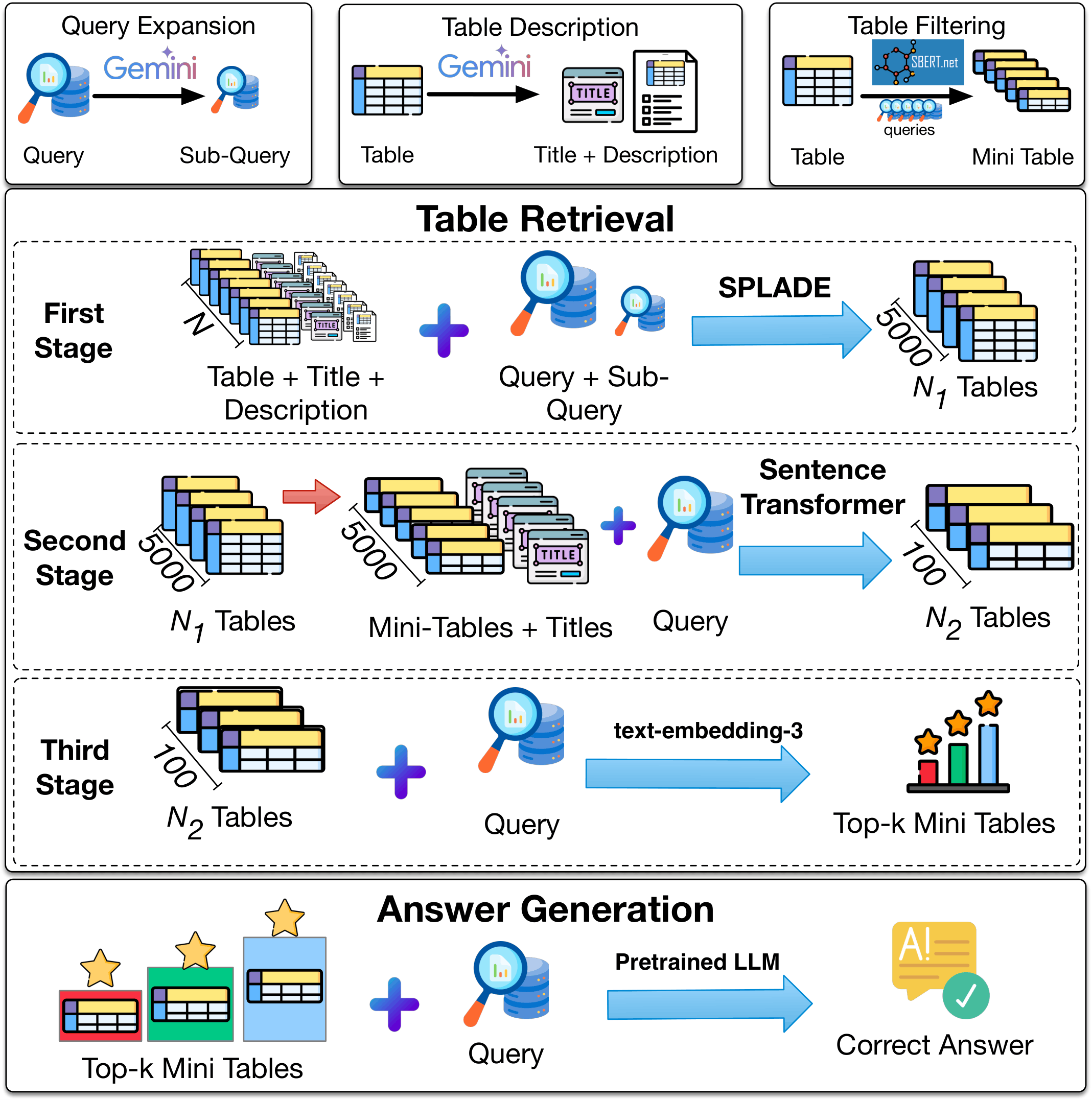
Figure 1: The CRAFT framework — preprocessing, three-stage retrieval, and answer generation.
Datasets it comes configured for
CRAFT ships with configs for two open-domain table-QA benchmarks. You can also point it at your own table collection.
NQ-Tables
Wikipedia tables where each question is answered by a single table.
OTT-QA
Questions that reason across tables and passages.
The LLM-generated table titles/descriptions and question sub-questions for both
benchmarks are published on
 Hugging Face —
no need to regenerate them yourself.
Hugging Face —
no need to regenerate them yourself.
# download the pre-generated enrichment data
pip install huggingface_hub[hf_xet]
hf download AdarshSingh7647/nq-tables-craft-enrichment --repo-type dataset --local-dir datasets/NQ_Tables/craft
hf download AdarshSingh7647/ottqa-craft-enrichment      --repo-type dataset --local-dir datasets/OTT-QA/craft
Compact tables, smaller context
Once the top tables are retrieved, CRAFT can pass them to a language model to produce an answer. It sends mini-tables — each table's most relevant rows and its headers — rather than whole tables, so the context stays small enough for lightweight models to read.
BibTeX
@inproceedings{singh-etal-2026-craft,
    title = "{CRAFT}: Training-Free Cascaded Retrieval for Tabular {QA}",
    author = "Singh, Adarsh  and
      Bhandari, Kushal Raj  and
      Gao, Jianxi  and
      Dan, Soham  and
      Gupta, Vivek",
    editor = "Liakata, Maria  and
      Moreira, Viviane P.  and
      Zhang, Jiajun  and
      Jurgens, David",
    booktitle = "Proceedings of the 64th Annual Meeting of the {A}ssociation for {C}omputational {L}inguistics (Volume 1: Long Papers)",
    month = jul,
    year = "2026",
    address = "San Diego, California, United States",
    publisher = "Association for Computational Linguistics",
    url = "https://aclanthology.org/2026.acl-long.149/",
    doi = "10.18653/v1/2026.acl-long.149",
    pages = "3284--3298",
    ISBN = "979-8-89176-390-6"
}